Aging is a natural part of life, and with it come changes and challenges.
And while we love and respect our elders, we also realize that there are certain things that come with age besides wisdom. Physical changes in older people aren’t limited to their outer appearance.
So is there really something called “old person smell”?
Well, science says ‘yes’: There’s a distinct body odor that is a product of aging, commonly referred to as “old people smell”. We know that’s not a flattering term, but science has proven it exists. You’ve smelled it. It’s sort of musty with undertones of oil or grease, and it seems to come out of the pores.

This unique scent is a real biological phenomenon. Known scientifically as “nonenal”, it is a completely natural byproduct of aging skin rather than a reflection of personal hygiene or environmental factors. While society sometimes labels this aroma negatively due to ageist biases, blind scientific sniff tests demonstrate that most people actually perceive it as a mild, neutral, or slightly sweet scent. It is often described as resembling musty cardboard, aged wood, or vintage books.
You can find it in nursing homes, a relative’s house, or in the line at the grocery store, but again, understand it has little to do with hygiene. Scientists shared that the odor is caused by a compound called 2-nonenal. When hormones change as we age, our bodies produce more fatty acids in the skin.
Because our antioxidant levels decrease as we get older, those fatty acids are exposed to oxidation, which in turn produces high amounts of nonenal. It can remain on the skin even after washing, and largely exudes from the chest and back area.
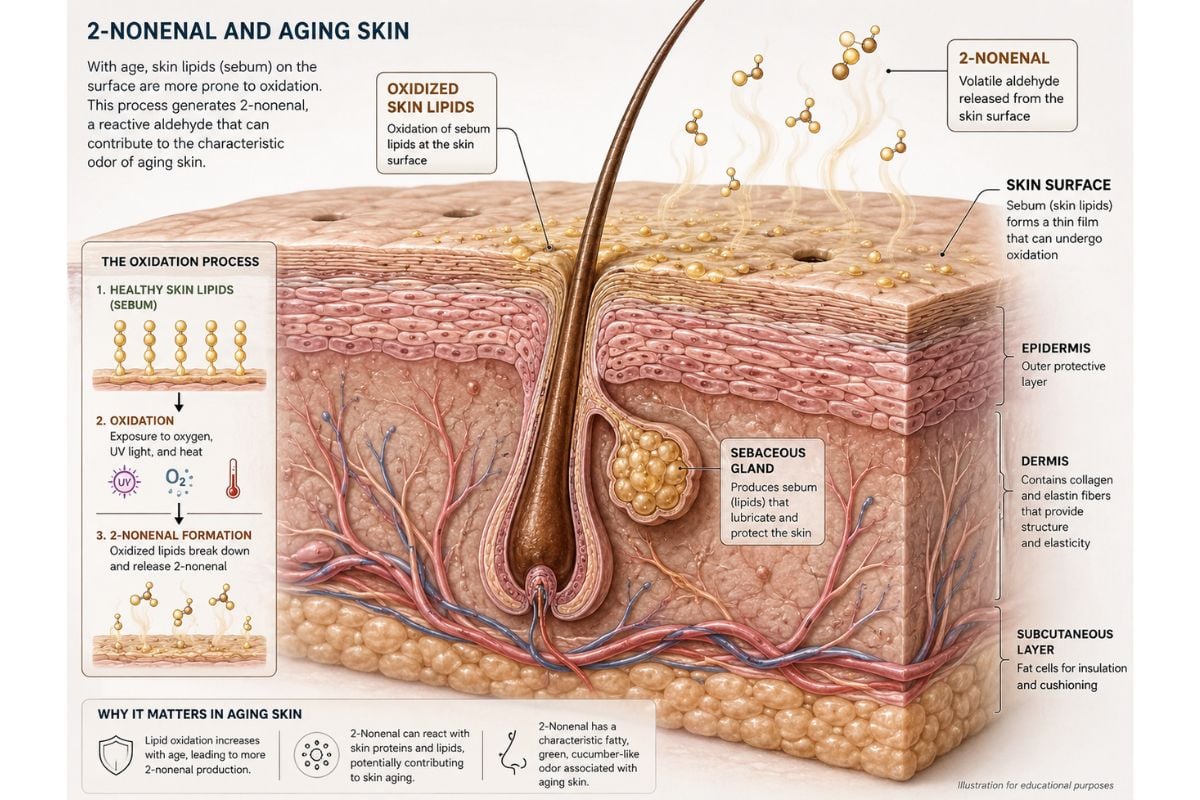
Around the age of 40, human skin chemistry begins to shift. The body produces more omega-7 unsaturated fatty acids while its natural antioxidant defenses simultaneously decline. This allows the skin’s surface lipids to oxidize—essentially a microscopic version of cooking oil turning rancid. As these fatty acids break down and react with oxygen, they generate the volatile compound 2-nonenal, which easily evaporates into the surrounding air.
There are several things that can heighten the intensity of the smell: confined spaces, dirty laundry, and dehydration. Illness and medications may also contribute to the odor. A 2001 study published in the Journal of Investigative Dermatology found that elderly subjects had a higher concentration of nonenal clinging to their clothing.
A more recent study from 2012 suggests that humans’ ability to discern the scent of old people from others may be linked to a subconscious connection to ancestors. Like animals, they could determine the age and health status of someone by odor.
The Japanese have a name for the smell – kareishu – and many companies in the country have come up with products to combat it. Body washes, perfumes, and other deodorizers exist that purport to help neutralize the odor. One ingredient, persimmon, is said to eliminate it completely from the skin.
Managing nonenal odor requires a different approach than dealing with standard body odor. Because 2-nonenal is a hydrophobic lipid compound, it is not water-soluble and clings tightly to the skin, meaning that standard soaps and rigorous scrubbing cannot easily wash it away. Furthermore, the compound easily transfers to fabrics and builds up over time in clothing and bedding.
To effectively neutralize nonenal, you must target its oil-based nature with specific cleansing and laundry strategies. Since standard soaps fail to dissolve these stubborn lipids, personal care products containing persimmon extract (tannins) and green tea extract are highly effective because they chemically bind to the compound and neutralize it on contact.
For deep body cleansing, focus on areas where sebaceous glands are most concentrated, such as behind the ears, the neck, and the chest. Additionally, because nonenal transfers to fabrics and resists normal washing cycles, you should wash clothing and bedding regularly at high temperatures and use oxygen bleach or baking soda to break down the embedded oils.
There are other things one can do to fight off what originates in the skin. Exercise helps with metabolism, so engaging in physical activities can help keep the hormones balanced and stress levels down. Another key step is to launder clothes regularly.
Because nonenal can easily build up on clothing, it may be necessary to wash your clothes more frequently. Eating a healthy diet that includes lots of antioxidants and water can aid the skin. Dehydration not only dries the skin, but can also contribute to odors that emit from the mouth and body.
Hygiene is only one step, but one of the simplest things you can do is to let some fresh air inside. Getting older is inevitable and it’s a natural part of life for the body to change. However, showing our elders compassion, respect, and love is something that will never get old.
Does this familiar odor bother you? Did you know there was a scientific reason behind it? What do think of specialized products that might neutralize the effects of nonenal?
Additional sources: PLOS One and Scientific American